Playing through chord changes
In this lesson, we will delve into some concepts that you could use when playing through chord changes. The chord progression I’ve selected is often referred to as the “Bruno Mars” sound in today’s era, but it draws its roots from chord progressions common in the 80s. During that era, bands frequently crafted progressions that bore a significant influence from jazz fusion music.
Having ability to navigate through chord changes are an important part of a guitarist’s skill set. It’s will open a whole new world of music to you. Think of it this way, there is a lot of music that have chord or key changes. Not knowing how to navigate through changes means, there is a big portion of music out there you will not be able to play on.
Chord Progression :
| F#m9 | B13sus2 | Bmaj7/C# | Gdim G7b9 |
Download the backing track by clicking on the three dots on the far right. You must be on desktop to download.
Rhythm Parts :
I’m using dyads to create the 16th note funk rhythm part. Dyads are two notes that imply the chord. As the song already has a lot of keyboards outlining the chords, the only way for guitars to cut through, is by playing less and on the higher registers. Through out the track, I play variations of the dyads below.
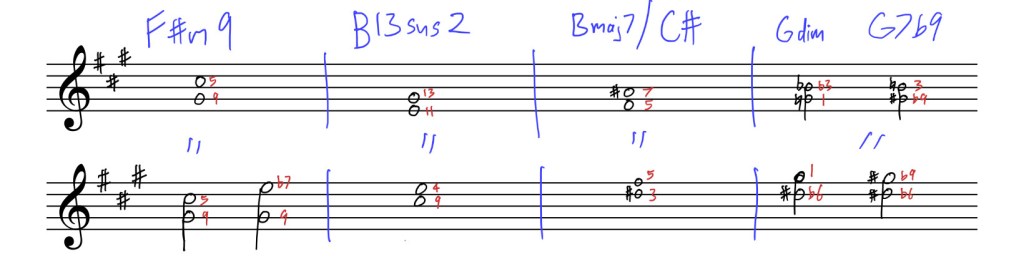
The intervals belonging to the chords are written in red. Eg, Instead of playing a full F#m9 chord, I am playing just the 5th and 9th.
Soloing :
This is a tricky four bar progression in the key of F# minor. It changes keys 3 times. Not the simplest of changes to navigate at this tempo. There are many ways we can approach this, but for this lesson we are going to be looking at just one.
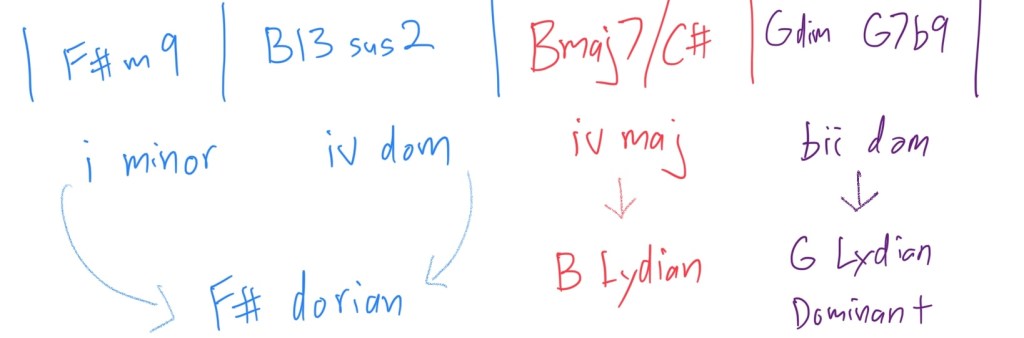
Here’s my thought process :
1. F#m9 and B13sus2 are 1 minor and 4 dominant. A trademark of the Dorian mode. F#m9 and B13sus2, belong to the same key – F# Dorian.
2. Bmaj7/C# is 4 major of F# Minor. Changing from B Dominant 13 to B Major 7 means we are no longer in F# Dorian. This is a key change to B major. Scale of choice, B Lydian.
3. G Diminish and G7b9. I am treating the G Dim as a passing chord to G7b9. G7b9 is not related to Bmaj7/C#, but is related to F#m9. It is the tri-tone substitution of C#7. Which is the 5 dominant chord leading back to F#m9. Scale of choice over this last bar, G Lydian Dominant.
Different musicians will approach this track differently. There are so many options you can use for the individual chords. Over time, you will find the sounds that you like best and develop vocabulary for it.
Hope you enjoyed this lesson. Download the backing track, give it a go and if you would like to take lessons or have questions. Please drop me an email. Thank you.
 b6an Music